The Geology Under Your Feet: Red Clay and Schist in Forsyth County
If you live in Winston-Salem, you already know the soil here is different. That thick, sticky red mud that clings to your boots after a rainstorm is more than a nuisance. It is Piedmont clay, and it is one of the main reasons so many local basements and crawl spaces struggle with water. Forsyth County sits squarely in the Piedmont region, where millions of years of weathering have left behind a dense layer of clay mixed with weathered rock, including schist and saprolite. This combination creates a soil profile that behaves very differently from the sandy or loamy soils you might find closer to the coast.
Red clay is made up of very fine particles that pack tightly together. When it is dry, it can become almost as hard as concrete. When it is wet, it expands and holds water like a sponge. Underneath that clay layer, the fractured schist and saprolite allow water to move in unpredictable ways, sometimes channeling it directly toward your foundation. Understanding this local geology is the first step toward understanding why your basement leaks and what can actually be done about it.
Why Clay Shrink-Swell Behavior Causes Foundation Cracks
The phrase 'clay shrink-swell' gets used a lot in foundation repair, and for good reason. During a dry North Carolina summer, the red clay around your home loses moisture and contracts. This creates a gap between the soil and your foundation wall, sometimes an inch or more wide. When the fall rains arrive, water rushes into that gap and the clay swells back up, pressing against your foundation with tremendous force. This cycle repeats every year, and over time it puts enormous stress on concrete block, poured concrete, and brick foundations alike.
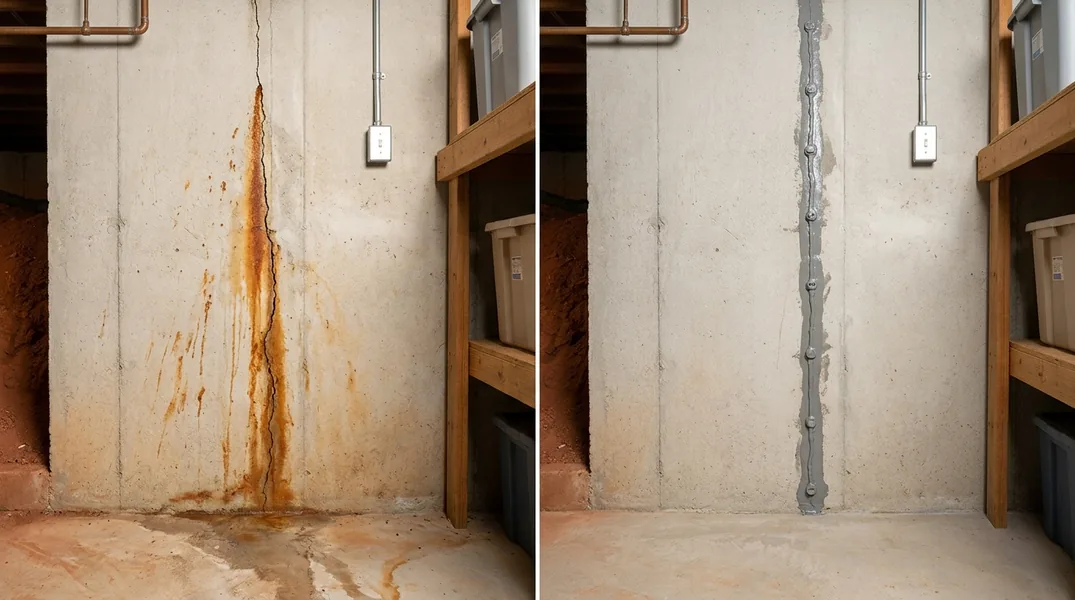
That constant movement is what leads to the hairline cracks you see in basement walls and floors. Those cracks are not just cosmetic. They are direct pathways for water to enter your home. If you have noticed new cracks appearing, widening cracks, or cracks that seem to close up in wet weather and open in dry weather, that is classic clay shrink-swell activity. Left unaddressed, this cycle can also cause bowing walls, sticking doors, and uneven floors. A professional assessment of your Foundation Waterproofing needs should start with understanding how the soil is moving around your specific home.
How Piedmont Soil Pushes Water Toward Your Basement
Water always takes the path of least resistance, and in the Piedmont, that path often leads straight to your foundation. Because clay drains very slowly, rainwater that falls on your yard does not soak in quickly. Instead, it sheets across the surface or saturates the top few inches before finally percolating downward. When it reaches the foundation, it has nowhere to go but against your basement wall or under your footing. The schist bedrock below can complicate things further by creating perched water tables, where water gets trapped above an impermeable layer and builds up pressure against your home.
This is why so many Kernersville and Winston-Salem homeowners notice water seeping in at the cove joint, where the floor meets the wall, rather than through obvious cracks. Hydrostatic pressure from saturated clay is relentless. It does not need a large opening to find its way inside. In many cases, the fix is not just sealing a crack but managing the water before it ever reaches the foundation. That is where a well-designed Basement Waterproofing system makes the difference.
Warning Signs of Soil Movement and Basement Water in Winston-Salem
Not every basement leak announces itself with a puddle. Some of the earliest signs of trouble are subtle. You might notice a white powdery substance on your basement walls, which is efflorescence, a mineral deposit left behind when water evaporates after moving through concrete. You might smell a musty, earthy odor that never quite goes away, even after you clean. You might see dark staining at the base of walls or find that stored boxes and furniture near the floor are damp or developing mold. These are all clues that water is moving through your foundation.
On the exterior, look for soil that has pulled away from the foundation, creating a visible gap. Check for downspouts that discharge too close to the house or grading that slopes back toward the walls instead of away from them. In neighborhoods around Clemmons and Lewisville, we often see driveways and patios that were poured right against the foundation with no drainage plan, which funnels runoff directly into the basement. If any of this sounds familiar, it is worth getting a professional opinion before the next heavy rain season arrives.
Basement Waterproofing Near Me: Solutions That Work With Piedmont Soil
The right solution for a Winston-Salem home depends on where the water is coming from and how the soil is behaving. For many homes, an Interior Drain Tile System is the most reliable approach. It intercepts water at the cove joint and directs it to a sump pump before it can spread across your floor. This system works with the natural movement of the clay rather than fighting it, and it can be installed without excavating your entire yard. For homes where the problem is primarily exterior, Exterior Basement Waterproofing may involve improving drainage, sealing the exterior wall, and correcting grading so water never accumulates against the foundation in the first place.
No two yards in Forsyth County drain the same way. A home at the bottom of a slope in Lewisville faces different challenges than a flat lot in Winston-Salem. That is why a proper evaluation matters more than a one-size-fits-all kit from a hardware store. If you are searching for 'basement waterproofing near me' and want a solution built for local soil conditions, the team at Winston-Salem Waterproofing can assess your situation and recommend a plan that addresses the root cause. Call (336) 666-2424 to schedule a free estimate and get clear answers about what your home needs.
Basement Waterproofing Cost in Winston-Salem: What to Budget
Homeowners often ask what waterproofing will cost before they understand what is involved. The honest answer is that it depends on the size of your basement, the severity of the water intrusion, and which system is right for your home. A simple crack injection or spot repair costs far less than a full perimeter drain tile installation. Exterior work that requires excavation typically carries a higher price tag than interior solutions. Rather than guessing, it is better to get a written scope of work that explains exactly what will be done and why.
At Winston-Salem Waterproofing, we believe you should understand the pricing before any work begins. We provide clear estimates with no pressure and no hidden fees. Investing in proper waterproofing now is almost always less expensive than repairing foundation damage, replacing finished basement materials, or remediating mold later. For a straightforward conversation about your home and your budget, reach out to our team. We serve homeowners throughout Winston-Salem and the surrounding communities, and we are happy to help you weigh your options.
Looking for a professional basement waterproofing contractor in Winston-Salem? Winston-Salem Waterproofing responds fast for all your basement waterproofing needs.
Get a Free QuoteOur services: Basement Waterproofing · Interior Drain Tile System · Exterior Basement Waterproofing