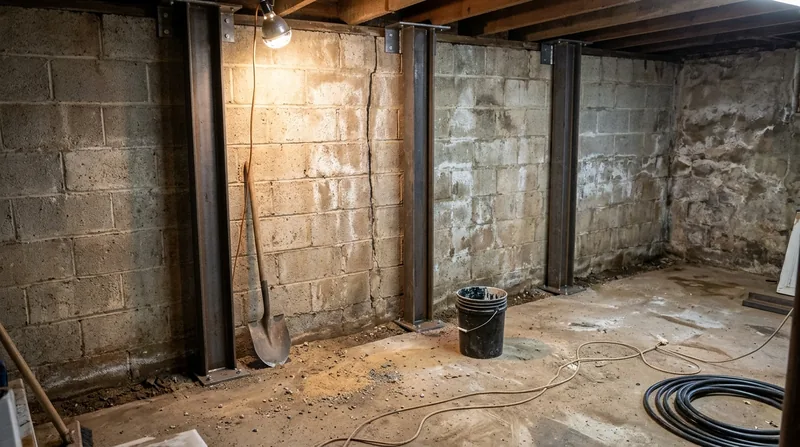




Winston-Salem sits on red Piedmont clay over decomposed granite and schist, ground that swells hard when wet and shrinks when dry, and that movement pushes directly against older basement walls. If you have noticed a wall leaning inward in Ardmore, West End, or Buena Vista, or a block wall in a 1950s Sherwood Forest ranch starting to curve, you need Bowing Wall Repair in Winston-Salem before the movement gets worse. The older stone and brick foundations in the 1900s-1930s foursquares and Tudor homes were built with clay footing drains that are now collapsed or root-filled, so saturated clay backfill keeps loading those walls season after season. We stabilize bowing and leaning foundation walls with carbon fiber straps, steel I-beams, or wall anchors, matched to how far the wall has moved and what your soil is doing. Call (336) 666-2424 for a free basement inspection, or read our foundation crack repair page if the wall is cracked but still straight.
Why Bowing Walls Are Common in Winston-Salem's Older Basements
Most bowing walls we see in Winston-Salem are not a mystery. The backfill is heavy clay that holds water, the footing drain is a hundred years old or gone, and the wall was never designed for that load. In Waughtown, mill-era frame houses sit on low brick piers with shallow basements, and in the 1940s-1960s brick ranches around Washington Park the lower levels were partly finished with no real drainage behind the wall. When Salem Creek, Peters Creek, or Silas Creek floods low neighborhoods in a big storm, the water table rises and hydrostatic pressure does the rest.
- Saturated clay backfill pushes inward on block and stone walls, causing horizontal cracks and a visible bow.
- Old clay footing drains clog with roots and silt, so water stays in the soil instead of draining away.
- Freeze-thaw nights in winter force water into hairline cracks and widen them each cycle.
- Downspouts that dump at the foundation and grading that slopes toward the house add load every rain.
Any of those signs means the wall is still moving, and the repair should address the soil pressure, not just the visible crack.
Key info: A block wall in a 1920s West End basement that has bowed two inches over ten years is a different repair than a poured wall in a 1990s Clemmons walkout that moved after one wet spring. We measure the movement and check the soil before we recommend straps, beams, or anchors.
Structural foundation repair in North Carolina is permitted work in most jurisdictions, and the local building department has the final say on what your project requires. You can check the City of Winston-Salem's permit information at cityofws.org before any work starts.
How We Repair a Bowing Wall in Winston-Salem
We start by finding out why the wall moved, because a strap on a wall that is still taking water is a temporary fix. We inspect the basement wall from the inside, check the grading and downspouts outside, and look for efflorescence, horizontal cracking, and evidence of hydrostatic pressure. Then we match the repair to the severity: carbon fiber straps for a wall that has bowed but is stable, steel I-beams for a wall that needs real lateral resistance, and wall anchors when the soil load is high and the wall has to be pulled back.
- We measure the bow at multiple points and record crack widths so we have a baseline.
- We check the footing drain and the soil moisture behind the wall to confirm the pressure source.
- We recommend carbon fiber straps, steel I-beams, or wall anchors based on movement and soil.
- We install the system, torque anchors or bond straps to the wall, and seal cracks as needed.
- We correct grading and downspout extensions so water stops reloading the same wall.
The goal is to stop the movement and stabilize the wall, not to hide it behind a fresh coat of paint.
Local example: A 1950s brick ranch near Sherwood Forest had a rear block wall bowing about 1.5 inches with a horizontal crack at mid-height. The clay backfill was saturated and the old footing drain was crushed. We installed carbon fiber straps on the interior, sealed the crack, and extended the downspouts, and the wall has held steady since.
If the wall is wet as well as bowed, our interior drain tile system page explains how we relieve the water pressure that caused the movement in the first place.
Repair Methods We Use for Bowing and Leaning Walls
No single method fits every wall. The right choice depends on how far the wall has moved, whether it is block, brick, stone, or poured concrete, and how much clay is pressing on it. Here is how we match the approach to the condition.
| Approach | Description | Best for |
|---|---|---|
| Carbon fiber straps | High-strength straps bonded vertically to the interior wall to resist further inward movement. | Block or poured walls with moderate bow and stable soil. |
| Steel I-beams | Vertical steel beams anchored to the floor and joists to brace the wall against lateral load. | Walls with significant bow or where straps alone are not enough. |
| Wall anchors | Anchors driven into stable soil outside and connected through the wall to pull it back. | Walls that have moved and need to be straightened, with high soil pressure. |
| Crack injection and sealing | Epoxy or polyurethane injection into cracks, plus sealing, to close the path for water. | Hairline and shrinkage cracks in otherwise stable walls. |
| Drainage correction | Grading, downspout extensions, and footing drain repair to reduce hydrostatic pressure. | Every bowing wall repair, because the water load has to come down. |
We often combine two methods, because a strap or beam holds the wall while drainage work removes the pressure that caused the bow.
Bowing Wall Repair Cost in Winston-Salem: What to Expect
Bowing wall repair is priced by the linear foot of wall, the method, and the access, so a single wall in a Washington Park basement is a smaller job than a full perimeter in a Lewisville walkout. As a starting point, simple crack injection and sealing starts from $600, while carbon fiber straps, steel I-beams, and wall anchors run higher because they are structural. The main cost drivers are the length of the bowed wall, whether the wall is block or poured, how far it has moved, and whether drainage correction is needed at the same time.
Getting two or three estimates is smart here, because the right repair depends on the diagnosis, and a contractor who only sells one method will sell you that method. Ask each one to explain why the wall moved and what they will do about the water. You can see our full range on the pricing page, and we give a written scope before any work begins.
What to Look for in a Bowing Wall Repair Contractor Near Winston-Salem
Hiring the right contractor matters more on structural work than on almost any other basement job, because a bad repair can leave the wall moving. Look for a company that is licensed and insured, that inspects the wall and the soil before quoting, and that will put the scope in writing. Ask for references from similar homes in Winston-Salem, Kernersville, Clemmons, or Lewisville, and ask whether the work requires a permit and who pulls it.
Check that the contractor carries liability and workers' compensation coverage and can provide a certificate on request. Ask how they handle permits with the local building department, since structural repair and drainage changes can trigger review, and confirm any HOA requirements before work starts. A written, transferable warranty on the repair is a good sign, and so is a contractor who tells you when a simpler repair is enough. Reach us through the contact page to schedule a free inspection.
Bowing Wall Repair Near Me: What Winston-Salem Homeowners Should Know
When you search for bowing wall repair near me in Winston-Salem, you will find general foundation firms, plumbers, and waterproofing specialists. The difference matters: a waterproofing specialist reads the water and soil first, because in this city the bow is almost always driven by saturated Piedmont clay and a failed footing drain. We are a dedicated basement waterproofing company, not a general foundation contractor, and we tell you plainly when crack sealing is enough and when hydrostatic pressure means you need drainage work plus structural support.
If the wall is wet, musty, or showing efflorescence, the water is still active, and the structural repair should come with a plan to relieve that pressure. Call (336) 666-2424 and we will inspect the wall, measure the movement, and give you a straight answer on what it needs.
Bowing Wall Repair in Winston-Salem: Pricing Guide
| Service | Price | Details |
|---|---|---|
| Crack injection and sealing | Starting at $600 | Covers cleaning, injection ports, and epoxy or polyurethane injection for stable hairline and shrinkage cracks. |
| Carbon fiber strap installation | Starting at $1,200 | Includes straps bonded to the interior wall; price rises with wall length and number of straps needed. |
| Steel I-beam bracing | Starting at $2,500 | Includes beams anchored to floor and joists; cost moves with wall height and access inside the basement. |
| Wall anchor system | On estimate | Requires an on-site look at soil conditions, wall movement, and exterior access before a number is given. |
| Travel | Included | In Winston-Salem and surrounding areas, with no separate call-out or mileage fee added. |
| Estimate | Free | Response within 24 hours at (336) 666-2424, with no obligation to book the work. |
Indicative pricing, the exact cost depends on square footage, finish, and site access. Free personalized estimate within 24h at (336) 666-2424.


